

For the majority of Deaf learners, the school experience leaves them in need of further tuition, particularly in English. While many hearing teachers of the Deaf do learn Sign Language, the vast majority lack a depth of fluency and deep understanding of Deaf Education practices needed to teach Deaf learners effectively.
English tuition at eDEAF is the last opportunity many learners will have to learn the basics of English grammar needed in the workplace. What they may have missed out on at school, they receive in an expertly developed curriculum, delivered by Deaf facilitators.
Learners come to eDEAF looking for solutions. They have had doors closed in their faces since their childhoods and now they are ready to take control of their futures. The English tuition they encounter at eDEAF is warm, welcoming, delivered by Deaf facilitators, and very importantly, always improving.
Why We Teach English at eDEAF
English is the basis of all written communication across the globe. If you can communicate effectively in English, you are able to make yourself understood and understand others.
At eDEAF, we prepare learners for the workplace. That means that every aspect of their tuition helps guide them toward being contributing members of society and the organisation in which they are placed.
Did you know that more than 90% of deaf babies are born to hearing families? In addition, children in South Africa are typically only diagnosed at around 2.5 years old. That means that for the first 2 years of their life, the majority of deaf babies do not receive the language input and stimulation that their hearing peers receive.
That language delay is not immediately rectified upon diagnosis. Once a hearing parent learns of their child’s deafness, they must embark on a journey of grief and acceptance and then follow their child’s lead and the advice of professionals to decide which mode of communication to use with their child.
They can choose to use Sign Language, spoken language, or a mixture of both, called Total Communication.
For those parents choosing to use Sign Language with their deaf child, they will need to learn the language, too. That means that, although there is now some form of communication occurring in the home, it is not on the level of a 2.5-year-old hearing child.
Let’s consider the differences in how that might look.
A typical hearing child of this age may say something like:
- “I want juice.”
- “Doggy run.”
- “I want Mommy.”
A deaf child of the same age who is learning to sign or communicate for the first time may use the following signs:
- “mommy/daddy”
- “eat/food”
- “drink/water”
- “come”
You can see that while the hearing child is beginning to form sentences and combine words to interact on a deeper level with their family, while the deaf child is learning rudimentary vocabulary needed to communicate basic needs.
Unfortunately, this delay does not disappear the moment the child and their family start using Sign Language. It is something that will accompany the child throughout their life and if they do not receive tuition in a way they can understand, it will only increase as it filters into literacy and, therefore, other areas of schoolwork.
How We Teach English at eDEAF
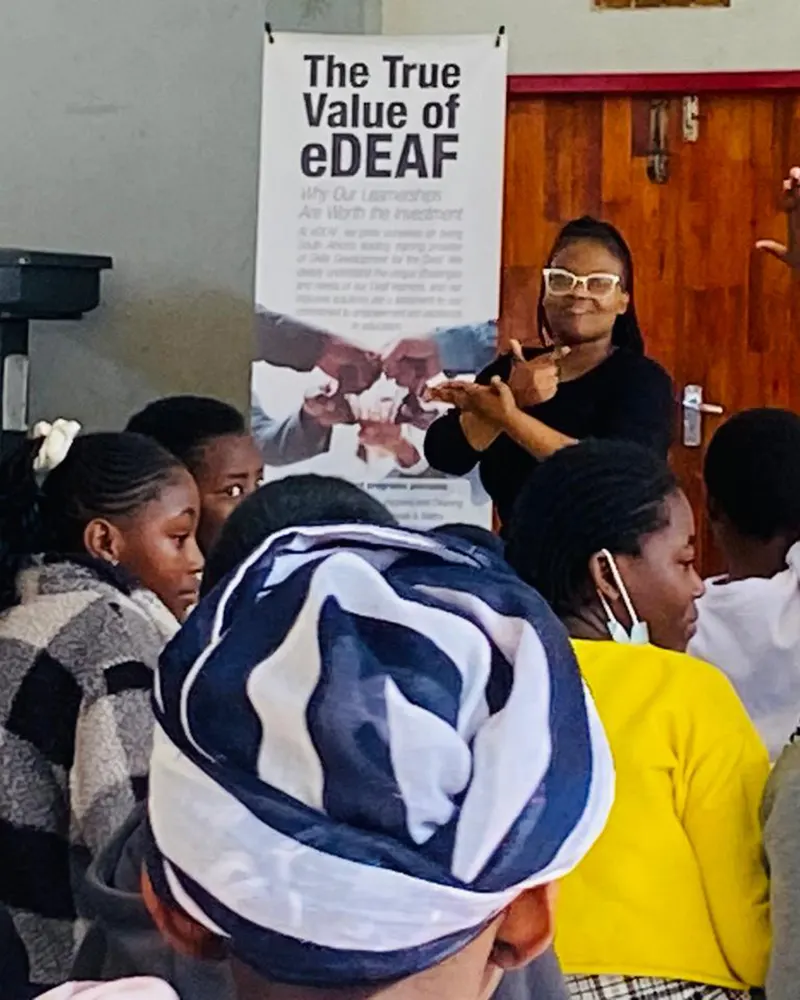
At eDEAF, we take the approach that Deaf learners learn best from Deaf facilitators.
According to DeafSA, the reading age of the average Deaf school leaver is around 8 years old, and while many schools for the deaf use South African Sign Language (SASL) as the language of learning and teaching, a 2009 University of Cape Town report indicated that only 14% of teachers had well-developed SASL skills. This suggests a significant gap between the language needs of Deaf learners and the proficiency of their teachers.
That’s why we make use of our trained, skilled facilitators to share their knowledge and understanding of all learning areas with our unique learners.
Teaching Deaf learners using the medium of South African Sign Language (SASL) means that learners at eDEAF are able to delve deeply into concepts, ask thoughtful questions and truly grasp a deep understanding of what they are learning in the classroom and online.
Teaching English to Deaf learners needs a different approach than what is used when teaching hearing learners. Deaf Education specialists know that there are specific methods that work well with Deaf learners. Through years of research and classroom practice, they have developed and keep developing more appropriate approaches to education in a Deaf classroom.
It is with this approach that we teach our learners and keep improving on our English curriculum at eDEAF.
We are committed to providing our learners with the best tuition in English and allowing them to grasp the basics from which to build toward competency in Business English.
In Conclusion
Having a solid foundation in English is vital for participation in the workplace and society. At eDEAF, we take the quality tuition of our learners seriously. We believe that while learners may have missed out on gaining a deep understanding of English concepts during their school years, they have the opportunity to grasp these all-important concepts during their time with us. This is their time, and when they have been taught effectively, you receive staff members who have a higher quality of literacy and participation in your workplace.
Cape Town
4th Floor Fairland House
Victoria Road
Observatory, Cape Town
Western Cape
011 837 7432
067 202 0202 *
* WhatsApp only
Centurion
1025 Bank Avenue,
Centurion Central,
Centurion
011 837 7432
Durban
180 Steve Biko Road
Berea
Durban
KwaZulu Natal
031 202 5939
Johannesburg
22 Solomon Street
Cnr Smit Street
Braamfontein
Gauteng
011 837 7432
Information Technology (IT Learnership)
Build Digital Skills for the Future
The IT Learnership equips Deaf learners with the technical and problem‑solving skills needed for today’s digital world.
Delivered in SASL by Deaf facilitators, this programme opens doors to exciting careers in technology.
What You’ll Learn:
- Computer literacy & digital fundamentals
- Hardware & software basics
- Networking essentials
- Troubleshooting & problem‑solving
- Professional digital communication
Career Opportunities:
-
IT support technician
-
Helpdesk assistant
-
Junior technician
-
Digital office assistant
Why It’s Perfect for Deaf Learners:
Deaf learners are strong visual thinkers — a natural fit for IT environments that rely on logic, patterns, and visual problem‑solving.
Wholesale & Retail Learnership
Develop Practical Skills for Customer‑Focused Careers
This learnership prepares Deaf learners for roles in retail, merchandising, stock control, and customer service.
Training is hands‑on, visual, and delivered in SASL to ensure full understanding.
What You’ll Learn:
-
Customer service fundamentals
-
Point‑of‑sale operations
-
Merchandising & stock management
-
Workplace safety & hygiene
-
Professional behaviour & teamwork
Career Opportunities:
-
Retail assistant
-
Merchandiser
-
Stock controller
-
Cashier
-
Store support staff
Why It’s Perfect for Deaf Learners:
Retail environments benefit from Deaf employees’ focus, attention to detail, and strong visual awareness.
Hygiene & Cleaning Learnership
Gain Skills for Essential Workplace Roles
This learnership equips Deaf learners with the knowledge and practical skills needed for professional cleaning and hygiene services across industries.
What You’ll Learn:
-
Cleaning techniques & best practices
-
Use of cleaning equipment
-
Health & safety procedures
-
Infection control
-
Time management & task planning
Career Opportunities:
-
Hygiene assistant
-
Cleaning technician
-
Facilities support staff
-
Hospitality cleaning roles
Why It’s Perfect for Deaf Learners:
Deaf learners excel in structured, routine‑based environments where precision and consistency matter.