

Deaf culture is rich, vibrant, and deeply rooted in community and language. For employers, understanding Deaf culture is essential to building inclusive workplaces where Deaf employees feel respected and valued.
Here’s what every South African employer should know.
1. Deaf Culture Is a Culture — Not a Disability
Deaf people do not see themselves as “hearing impaired.” They see themselves as part of a cultural and linguistic community.
South African Sign Language (SASL) is central to this identity.
2. SASL Is Not English on the Hands
SASL has its own grammar, structure, and linguistic rules. It is a complete language — not a translation of English.
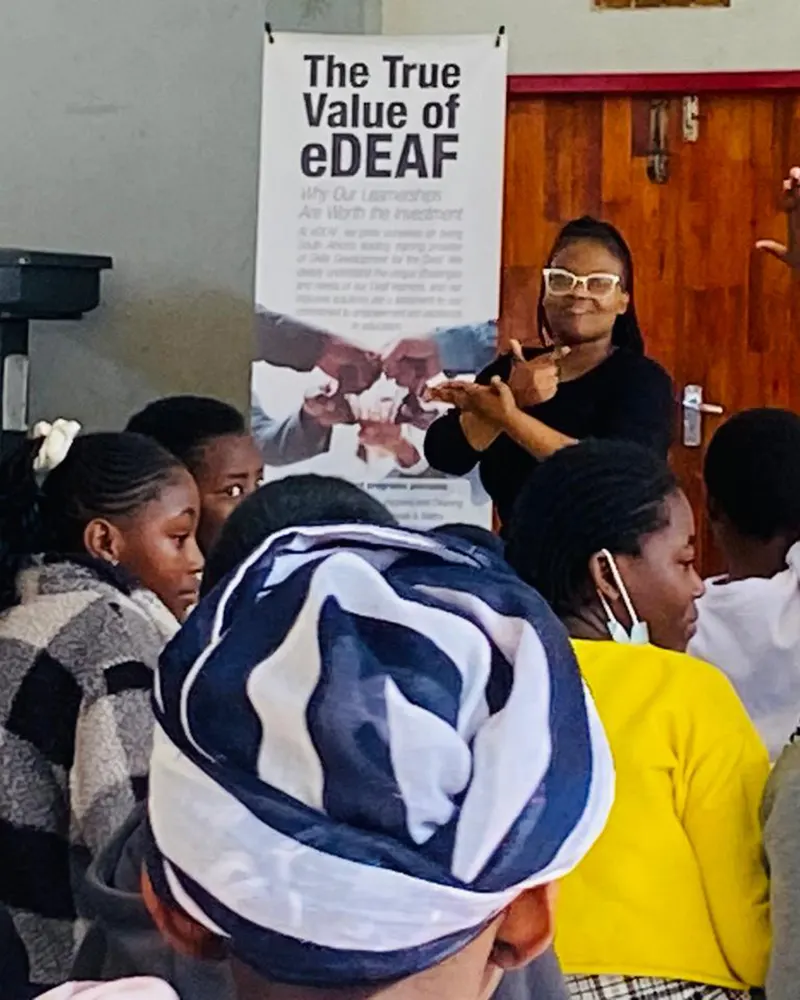
This is why Deaf‑led training is so effective: it uses the learner’s natural language.
3. Communication Norms Are Different — and Beautiful
In Deaf culture:
- Eye contact is essential
- Visual attention is respectful
- Tapping someone lightly is normal
- Facial expressions carry meaning
Understanding these norms builds trust and connection.
4. Deaf People Are Visual Thinkers
This is a strength. Deaf employees excel in roles requiring visual processing, pattern recognition, and spatial awareness.
5. Inclusion Requires Intentionality
Employers don’t need to be fluent in SASL — they simply need to be willing to learn, adapt, and communicate openly.
Final Thought
When employers embrace Deaf culture, workplaces become more inclusive, more innovative, and more human.
Book a Deaf sensitisation session with eDEAF to empower your team.
Cape Town
4th Floor Fairland House
Victoria Road
Observatory, Cape Town
Western Cape
011 837 7432
067 202 0202 *
* WhatsApp only
Centurion
1025 Bank Avenue,
Centurion Central,
Centurion
011 837 7432
Durban
180 Steve Biko Road
Berea
Durban
KwaZulu Natal
031 202 5939
Johannesburg
22 Solomon Street
Cnr Smit Street
Braamfontein
Gauteng
011 837 7432
Information Technology (IT Learnership)
Build Digital Skills for the Future
The IT Learnership equips Deaf learners with the technical and problem‑solving skills needed for today’s digital world.
Delivered in SASL by Deaf facilitators, this programme opens doors to exciting careers in technology.
What You’ll Learn:
- Computer literacy & digital fundamentals
- Hardware & software basics
- Networking essentials
- Troubleshooting & problem‑solving
- Professional digital communication
Career Opportunities:
-
IT support technician
-
Helpdesk assistant
-
Junior technician
-
Digital office assistant
Why It’s Perfect for Deaf Learners:
Deaf learners are strong visual thinkers — a natural fit for IT environments that rely on logic, patterns, and visual problem‑solving.
Wholesale & Retail Learnership
Develop Practical Skills for Customer‑Focused Careers
This learnership prepares Deaf learners for roles in retail, merchandising, stock control, and customer service.
Training is hands‑on, visual, and delivered in SASL to ensure full understanding.
What You’ll Learn:
-
Customer service fundamentals
-
Point‑of‑sale operations
-
Merchandising & stock management
-
Workplace safety & hygiene
-
Professional behaviour & teamwork
Career Opportunities:
-
Retail assistant
-
Merchandiser
-
Stock controller
-
Cashier
-
Store support staff
Why It’s Perfect for Deaf Learners:
Retail environments benefit from Deaf employees’ focus, attention to detail, and strong visual awareness.
Hygiene & Cleaning Learnership
Gain Skills for Essential Workplace Roles
This learnership equips Deaf learners with the knowledge and practical skills needed for professional cleaning and hygiene services across industries.
What You’ll Learn:
-
Cleaning techniques & best practices
-
Use of cleaning equipment
-
Health & safety procedures
-
Infection control
-
Time management & task planning
Career Opportunities:
-
Hygiene assistant
-
Cleaning technician
-
Facilities support staff
-
Hospitality cleaning roles
Why It’s Perfect for Deaf Learners:
Deaf learners excel in structured, routine‑based environments where precision and consistency matter.